


Every child is different. Some need more support with communication. Others struggle most with transitions, sensory input, or emotional regulation. Autism is a neurodevelopmental condition that affects how a person communicates, learns, behaves, and experiences the world, and signs may become noticeable early in development.
If you are trying to figure out how to help your autistic child, start by understanding what helps them feel safe, understood, and able to succeed in daily life.
This guide combines autism basics, practical parent support, and ABA-informed strategies you can use at home. It is written to help you take the next right step, not to do everything at once.
Reassurance: Start small. One better routine, one clearer communication support, and one calmer response can make a real difference.
Helping your autistic child starts with understanding how they communicate, regulate, and learn. This parent and caregiver guide explains what autism can look like in daily life, when to seek support, and how to use practical, ABA-informed strategies at home to build communication, confidence, and independence.
What autism can look like in daily life
Autism can show up in communication, play, routines, sensory processing, flexibility, and social connection. One child may have few spoken words. Another may talk a lot but still struggle with conversation, peer interaction, or understanding social cues. CDC and NHS resources both reflect that autistic children may have social-communication differences, repetitive behaviors, anxiety, sensory challenges, and day-to-day support needs.
What matters most is the pattern over time. If daily life regularly feels harder because of communication breakdowns, big reactions to change, or difficulty participating in routines, it is reasonable to look more closely.
| What you may notice | What can help now |
|---|---|
| Difficulty expressing needs | Use short phrases, visuals, and functional words like “help” or “break” |
| Hard transitions or resistance to change | Use countdowns, First-Then language, and visual schedules |
| Sensory overload or sensory seeking | Adjust the environment, add movement breaks, and create a calm space |
| Social or play differences | Practice short turn-taking routines and model simple language |
| Strong interests or repetitive patterns | Use interests as motivators and bridges to new skills |
If your child has words but still struggles socially, AIA’s Why My Child Can Talk but Still Struggles Socially is a strong internal companion because it explains pragmatic language and nonverbal cues in parent-friendly language.
When to seek support
Many parents wait because they do not want to overreact. Still, if you are seeing repeated concerns with communication, social interaction, play, sensory regulation, or developmental milestones, it makes sense to ask questions early. CDC notes that some children show signs in the first year, while others show them later.
A practical first step is to talk with your child’s pediatrician. Ask for a developmental screening, share examples from home, and request a referral if needed. Screening is not the same as diagnosis. Screening flags possible concerns. Diagnosis is a formal evaluation by a qualified professional.
AIA’s Autism Evaluation in Arizona: A Parent’s Step-by-Step Guide explains that distinction clearly and outlines common diagnostic professionals in Arizona.
Quick tip: Keep a simple note for two weeks. Write down what happened before a hard moment, what your child did, and what helped. Patterns are often more useful than isolated memories.
What ABA is, and how it can help at home
Applied Behavior Analysis, or ABA, is a behavioral approach that looks at what happens before and after behavior and uses structured teaching to build useful skills. CDC describes ABA as a notable behavioral treatment for autism that aims to improve a variety of skills.
At its best, ABA is individualized, practical, and respectful. It can support communication, daily living, emotional regulation, play, transitions, and independence. It should not be one-size-fits-all, and it should focus on meaningful skills your child can use in real life.

AIA’s Starting ABA Therapy Step-by-Step Guide and Positive Reinforcement in ABA Therapy to Encourage Skill Development are useful next reads if you want a clearer picture of how home support, parent consultation, and skill-building fit together.
| ABA principle | Everyday meaning |
|---|---|
| Positive reinforcement | Rewarding success so a skill is more likely to happen again |
| Breaking skills into steps | Teaching one manageable piece at a time |
| Prompting and fading | Giving support, then gradually reducing it |
| Replacement skills | Teaching what to do instead of only correcting behavior |
| Generalization | Using the same skill with different people and in different places |
The most realistic way for parents to use ABA at home is not to become the therapist. It is to learn a few dependable tools and use them consistently in daily routines.
How to support communication at home
Communication is more than speech. Many autistic children communicate through gestures, movement, pictures, devices, scripts, or behavior before they can communicate consistently with words. NHS guidance supports keeping language simple, allowing extra processing time, and using pictures or symbols when helpful.
A helpful question is, “Did my child understand me, and did they have a workable way to respond?” When adults move too fast, use too many words, or ask too many questions, communication often breaks down before behavior does.
Try these core supports:
- Use short, direct phrases.
- Pair words with visuals or gestures.
- Offer simple choices.
- Pause after speaking.
- Teach and honor words or signals such as “help,” “break,” “more,” and “all done.”
If your child has strong vocabulary but weak conversation or peer skills, that may be a pragmatic language issue rather than a language issue. AIA’s Why My Child Can Talk but Still Struggles Socially can help you spot that difference.
How to support routines, transitions, and behavior
Many hard moments happen around the same points in the day, getting dressed, ending screen time, leaving the house, starting homework, or bedtime. Competitor pages across NHS, HelpGuide, Thrive, and ABA-provider content repeatedly emphasize structure, routine, and visual support because they reduce uncertainty and make expectations clearer.
Instead of waiting to react, look at what happens before the behavior. Is the direction unclear? Is the task too long? Is the transition too sudden? Is your child already tired or overloaded? Proactive changes often work better than corrective reactions.
A few home strategies go a long way:
- Use a visual schedule or first, next, last routine.
- Give warnings before transitions.
- Use First-Then language.
- Teach replacement responses, such as asking for help or a break.
- Reinforce the behavior you want to see right away.
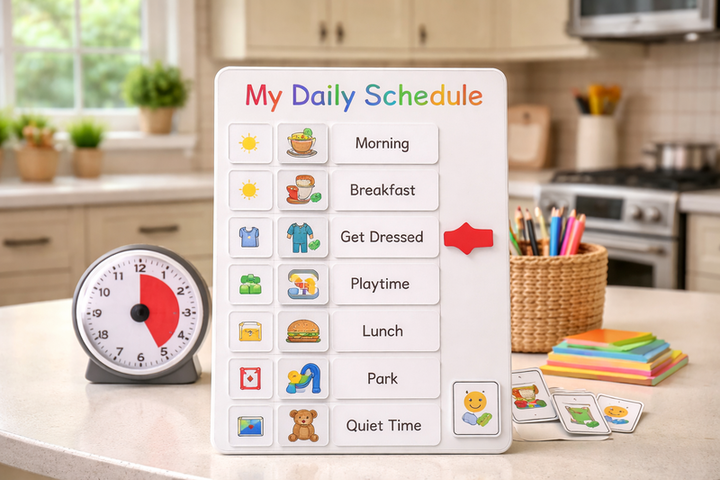
AIA’s First/Then Cards: Empowering Transitions for Autistic Children is a strong fit if transitions are a major trigger, and Why Emotional Regulation Should Be the Heart of Every ABA Program connects regulation with communication and change.
Pitfall to avoid: Do not save all of your praise for the end. Catch the smallest successful step and name it right away.
How to support sensory needs and regulation
Sensory differences are common in autism. Some children are overwhelmed by sound, light, textures, or busy spaces. Others seek movement, pressure, chewing, or visual stimulation. The National Autistic Society notes that autistic people may be more or less sensitive to sensory experiences and may seek out, avoid, or become overwhelmed by sensory input.
Sensory support works best when it is individualized. Not every hard moment is sensory, but a child who feels overloaded will usually have a much harder time communicating, transitioning, or staying regulated.
Try building your plan around three questions: What overwhelms my child? What helps them recover? What can I change before the hard moment starts? AIA’s Executive Functioning Skills & Autism is a helpful internal link for routines, visual supports, and coping tools.
Building independence in everyday routines
Independence grows in ordinary moments, not only in therapy sessions. Shoes. Hand washing. Cleaning up. Waiting. Asking for help. These routines are where children practice communication, regulation, flexibility, and confidence.
This is why breaking tasks into small steps matters. Thrive and LeafWing both emphasize step-by-step teaching, prompting, and fading support so children can do more on their own over time.
Start with one routine that already happens every day. Teach when everyone is calm. Use the least help your child needs to succeed. Then praise specifically. AIA’s Guide to Teaching Self-Advocacy in ABA and Enhancing Generalization for Broader Impact in Autism are strong follow-up reads if your goal is independence across home, school, and community.
Working with therapists, school, and family
Children usually make faster progress when the adults around them use similar language, expectations, and supports. That does not mean everyone has to parent the same way. It means your child should not have to relearn the rules in every room.
A short caregiver plan can help. Agree on one or two goals, the words adults will use, common triggers, and what helps calm or redirect. AIA’s Starting ABA Therapy Step-by-Step Guide and Helpful Autism Diagnosis & Therapy FAQs both reinforce the value of parent consultation and regular progress review.
Take care of yourself, too
A strong autism parent guide should say this plainly: your regulation matters too.
Self-care does not have to be elaborate. It may mean lowering one unrealistic expectation, asking for help with one hard transition, or building a few quiet minutes into your day. AIA’s Discover Self-Care Hacks for Parents of Children with Autism keeps this practical and realistic.
Final thoughts
Supporting a child with autism is not about finding one perfect strategy. It is about learning how your child communicates, what helps them regulate, and how to build success into ordinary moments. Start with what matters most in your family right now, then build from there.
If you want help thinking through assessment, therapy options, or next steps, AIA’s Client Consultation Form is the clearest next step.