


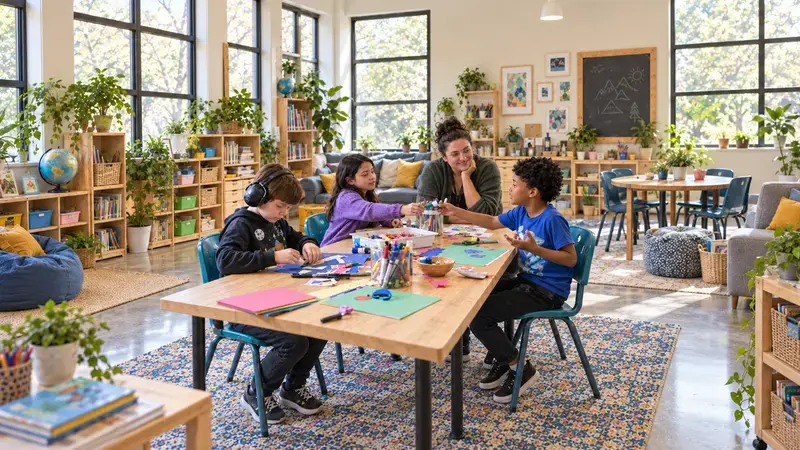
Social skills are part of how children communicate, participate with other people, build relationships, solve problems, express boundaries, handle emotions, stay safe, and become more independent.
They also change considerably as children grow. Sharing space with another toddler, participating in a kindergarten activity, resolving a disagreement in elementary school, and navigating peer pressure as a teenager all involve social development, but they require very different skills.
Social skills become more complex as children grow, moving from functional communication and shared play toward friendship, conflict resolution, self-advocacy, boundaries, and greater independence. For autistic children, age alone should not determine social goals. Communication, developmental level, interests, sensory needs, safety, environment, and the child's own priorities all matter.
The age ranges in this guide are therefore not a checklist of skills every child should demonstrate on schedule. Children develop differently, and autistic development may not follow the same sequence or look the same as non-autistic development.
Instead, these age ranges illustrate how the social situations children encounter often change over time and how meaningful goals can change with them.
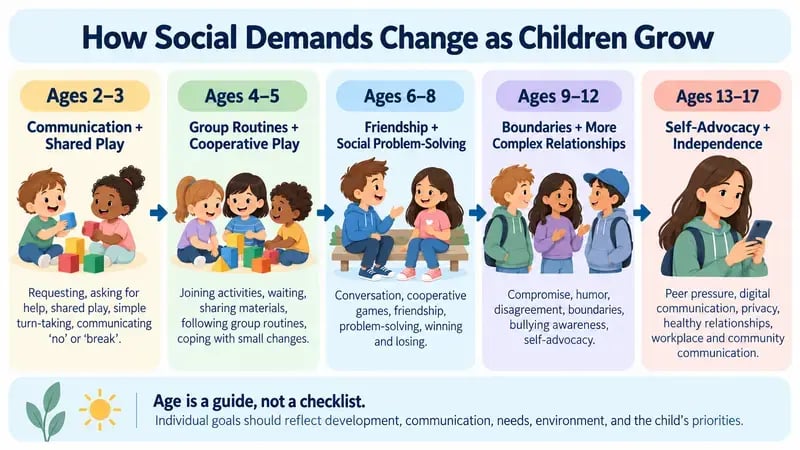
How Social Demands Change as Children Grow
Early social development is often centered on communicating needs, sharing activities with trusted adults, playing near other children, and beginning to participate in simple routines.
As children spend more time in school and community settings, social situations involve more people, less direct adult support, and more unwritten expectations. Friendships also become increasingly reciprocal and complex.
| Age range | Social environment often becomes more focused on | Examples of useful skills |
|---|---|---|
| 2–3 | Caregivers, early play, simple routines | Requesting, asking for help, shared play, simple turn-taking, communicating "no" or "break" |
| 4–5 | Preschool, kindergarten, group routines | Joining activities, waiting, sharing materials, following group routines, coping with small changes |
| 6–8 | Classroom and peer activities | Conversation, cooperative games, friendship, problem-solving, winning and losing |
| 9–12 | More complex friendships and groups | Compromise, humor, disagreement, boundaries, bullying awareness, self-advocacy |
| 13–17 | Increasing independence and broader relationships | Peer pressure, digital communication, privacy, healthy relationships, workplace and community communication |
These examples are most useful when they help adults ask, "What would make everyday life easier, safer, more enjoyable, or more independent for this child?" rather than, "What should a child this age look like socially?"
Early Childhood: Around Ages 2–3
At this stage, social development is closely connected with communication, play, and daily routines. Young children are still learning that communication can change what happens around them and that other people can be partners in enjoyable activities.
For an autistic child, meaningful social development might begin with finding reliable ways to communicate with caregivers and participate comfortably around other children. Spoken language is only one option. Gestures, signs, pictures, AAC, body movements, or other communication can serve the same functional purpose.
Examples of useful early skills can include:
- Communicating wants, needs, preferences, "no," "help," or "break"
- Sharing attention or enjoyment around an activity without requiring eye contact
- Imitating an action when imitation helps the child learn or participate
- Playing comfortably near another child
- Participating in a short back-and-forth activity
- Waiting briefly with appropriate support
- Moving between familiar activities
- Beginning to notice or respond to other people's emotions
A toddler does not need to hold conversations or actively play with a group for social development to be taking place. Becoming comfortable around another child, handing an adult an item for help, showing a favorite object, or taking two turns in a game can all be meaningful.
Parents who want to explore how communication can look beyond spoken words can read AIA's guide to communication and social skills in autistic children.
Preschool and Kindergarten: Around Ages 4–5
Preschool and kindergarten introduce a major change: children increasingly participate in situations where one adult is supporting several children at once.
That creates new social demands. A child might need to follow a group routine, wait while another child receives help, share materials, move from free play to circle time, or communicate with both adults and peers.
Useful skills during this stage might include:
- Greeting or responding to familiar people in a way that works for the child
- Joining or leaving an activity
- Taking turns and sharing materials with support
- Communicating with peers to request an item or suggest an activity
- Participating in simple cooperative play
- Waiting during familiar group routines
- Handling small changes with appropriate support
- Communicating frustration or requesting help before becoming overwhelmed
- Learning about personal space and simple boundaries
An important developmental shift also happens here: different settings begin to have different expectations.
Free play may allow movement, conversation, or changing activities whenever a child wishes. Circle time, lunch, a playground game, and a classroom activity each work differently. Learning to recognize those differences can support participation without requiring a child to suppress harmless autistic traits.
This is also why school readiness involves considerably more than letters, numbers, colors, or other academic abilities. Communication, group participation, flexibility, independence, and the ability to ask for help can all affect how comfortably a child participates in school.
Early Elementary Years: Around Ages 6–8
During the early elementary years, peer relationships often involve more back-and-forth interaction. Games have more rules, classroom projects require cooperation, and children spend longer periods interacting without an adult directing every step.
At this stage, a child may understand an individual social skill during structured practice but still find it difficult to use when a playground is loud, a game changes unexpectedly, or several children are talking at once.
Useful social goals might include:
- Starting, responding to, or ending a conversation
- Asking questions and making comments about a shared topic
- Joining a game or other peer activity
- Inviting another child to participate
- Following agreed-upon game rules
- Handling winning and losing
- Communicating when a rule or situation is confusing
- Resolving small disagreements
- Respecting another person's belongings and boundaries
- Asking for space, assistance, clarification, or a break
Friendship also begins to matter in a more individual way. A child may seek particular peers because of shared interests, compatible communication styles, similar humor, or simply because being together feels comfortable.
That relationship does not have to look highly verbal or constantly interactive to be meaningful. Two children building separately beside one another, drawing together, playing a predictable game, or talking extensively about a shared interest can all be connecting.
For more on supporting relationships without forcing a particular style of play, see Supporting Friendships and Social Play for Children with Autism.
Later Elementary and Preteen Years: Around Ages 9–12
By later elementary school, many social situations become less explicit. Children are expected to manage group projects, friendships, jokes, disagreements, exclusion, changing loyalties, and increasingly subtle communication.
Social success at this age also depends on skills that might not initially appear "social." Working memory, impulse control, flexible thinking, emotional regulation, and problem-solving can all affect what happens with peers.
A child might understand what to do in a calm conversation, for example, but have difficulty accessing that skill after losing a game or discovering that friends changed the plan.
Goals might include:
- Maintaining friendships over time
- Expressing a different opinion respectfully
- Negotiating and compromising when appropriate
- Recognizing teasing, bullying, manipulation, or unsafe behavior
- Knowing when to involve a trusted adult
- Understanding privacy and personal boundaries
- Coping with exclusion or disappointment
- Repairing a relationship after a disagreement
- Recognizing when another person wants to change or end an interaction
- Participating in group work without needing constant adult mediation
- Advocating for personal needs, preferences, and accommodations
Humor, figurative language, sarcasm, and unwritten group rules may also become more common. It can be useful to teach a child how to ask, "Are you joking?" or "What do you mean?" rather than assuming they must learn to infer every hidden meaning automatically.
Executive functioning may be part of this picture too. A child who knows a social expectation but struggles to pause, shift plans, regulate frustration, or consider options may need support with the underlying skill rather than another explanation of the social rule. AIA's guide to executive functioning skills and autism explores this connection further.
Adolescence: Around Ages 13–17
Adolescence brings greater independence, but it also brings social situations with higher stakes.
Teenagers may communicate with teachers, coaches, peers, employers, community members, and people online with less direct adult supervision. Friendships can deepen. Peer approval may matter more. Romantic interests may emerge. Digital communication adds another environment with its own boundaries and risks.
Social development during adolescence can therefore include:
- Maintaining friendships while respecting personal limits
- Participating in group conversations
- Communicating directly with teachers, coaches, or supervisors
- Asking for clarification or accommodations
- Handling disagreement without giving up the right to say no
- Recognizing peer pressure and unsafe requests
- Understanding privacy, consent, and relationship boundaries
- Using text, messaging, gaming, and social media safely
- Giving and receiving feedback
- Managing rejection or changes in friendships
- Recognizing trusted and unsafe people
- Practicing workplace or volunteer communication
- Making increasingly independent decisions
- Knowing when and how to ask for help
For teenagers, social instruction should increasingly support autonomy.
A teen should not merely learn what other people expect. They also need to know how to express what they expect, what they are comfortable with, when they disagree, when they want to leave, and when they need assistance.
These are social skills too.
AIA's Guide to Teaching Self-Advocacy in ABA discusses ways children and teens can practice communicating needs, choices, boundaries, and requests for support.
Social Development Is More Than Conversation or Eye Contact
"Social skills" is sometimes used so narrowly that it becomes almost synonymous with eye contact, greetings, and conversation.
That misses much of what children actually need.
Social development can involve functional communication, understanding and expressing emotions, cooperation, flexibility, safety, self-advocacy, problem-solving, boundaries, relationships, and knowing how to participate in different environments.
A highly verbal child may need considerable support with conflict resolution or identifying unsafe friendships. A child who speaks very little may communicate effectively with AAC, gestures, pictures, or another system and form meaningful relationships without relying on spoken conversation.
Likewise, looking directly into another person's eyes is not the same thing as listening, caring, understanding, or participating.
A useful social goal improves the child's ability to communicate, connect, participate, stay safe, or advocate for themselves. Looking more typical should not be the goal by itself.
Support Social Skills Without Forcing Masking
Autistic children should not have to hide harmless differences merely to appear more socially typical.
That means social instruction should be careful about goals such as forced eye contact, suppressing harmless stimming, requiring interaction when a child is overwhelmed, or teaching compliance without also teaching the right to say "no."
Instead, support can focus on skills that give the child more options.
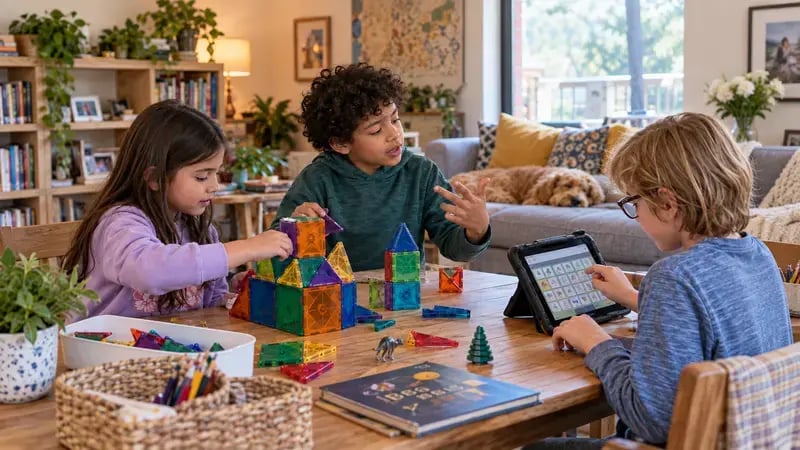
A child can learn ways to enter a game without being required to join every game. They can learn conversation skills while still being allowed quiet time. They can practice recognizing another person's boundaries while also learning that their own boundaries matter.
The adults and peers around the child also have a role. Clearer communication, patience, sensory accommodations, predictable expectations, shared interests, and acceptance of different communication styles can make an interaction more successful without demanding that the autistic child do all of the adapting.
Practice Skills Where They Will Actually Be Used
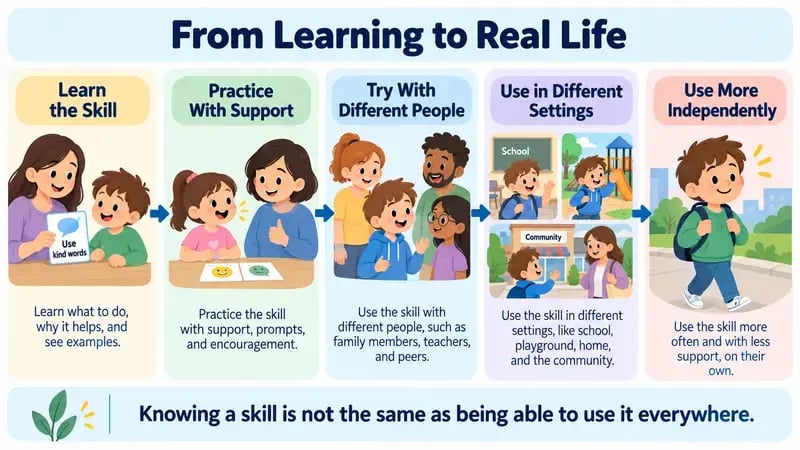
Learning a social skill in a quiet one-to-one setting is not the same as using it independently with several peers.
This is called generalization, and it is one of the most important parts of social learning.
A child who takes turns easily with a familiar adult may struggle when four children are playing the game. A child who rehearses how to ask for help may not use the phrase when embarrassed in class. A teenager may understand digital-safety rules during discussion but need additional practice recognizing pressure in an actual message.
Good teaching therefore moves gradually from explanation and supported practice toward different people, places, activities, and real situations.
The goal is not simply, "Can the child demonstrate the skill?"
A more useful question is, "Can the child use it when it matters, with enough independence to make everyday life easier or safer?"
What Social Groups Can and Cannot Do
One-to-one teaching can be useful for introducing a skill, but it cannot recreate every part of interacting with peers.
A well-designed group can create real reasons to communicate, wait, negotiate, cooperate, solve problems, handle small changes, and share interests. Games, art, music, projects, recreational activities, and community experiences can all create social opportunities without making conversation itself the entire activity.
Social groups are not automatically effective simply because children have been placed together, however.
A useful group should consider age, communication, interests, support needs, sensory environment, and the goals of the individual participants. Children also need opportunities to use skills beyond the group. Research on social-skills interventions has repeatedly shown that learning a skill in a structured program does not guarantee that it will automatically transfer to school, home, or the community.
For that reason, a group should be thought of as one possible practice environment, not a one-size-fits-all social curriculum.
When Additional Support May Help
Every child has strengths, preferences, and an individual developmental path. A difference from peers does not automatically mean a child needs intervention.
Additional support may be worth discussing, however, when social or communication difficulties are consistently preventing a child from doing something important to them or are creating significant safety, participation, or relationship concerns.
Examples might include a child who:
- Has lost communication, play, or social abilities they previously used
- Cannot reliably communicate basic needs, pain, help, or a desire to stop
- Wants friendships but repeatedly cannot find a way to join or maintain them
- Experiences frequent distress in ordinary social or group situations
- Is regularly excluded, bullied, manipulated, or unable to recognize unsafe interactions
- Cannot participate in school or community activities because social demands are overwhelming
- Has social difficulties that appear closely connected with language, sensory, emotional-regulation, or executive-functioning needs
A pediatrician can be a useful starting point for developmental concerns. Depending on the child's needs, support might also involve a speech-language pathologist, psychologist, occupational therapist, behavior analyst, school team, or another qualified professional.
The purpose of seeking support is not to make a child behave like everyone else. It is to understand what is getting in the way and identify skills, accommodations, or environmental changes that may improve everyday life.
Social Goals Should Grow With the Child
A strong social-skills plan should evolve.
For a young child, progress might mean communicating "help," sharing a play space, or taking a short turn.
For a first grader, it might mean joining a preferred game or recovering after losing.
For a preteen, it might mean recognizing when a joke has become hurtful and knowing what to do next.
For a teenager, it might mean telling a teacher they need clarification, declining peer pressure, setting a boundary in a friendship, or communicating appropriately with a supervisor.
Those goals are different because the child's world is different.
What should remain consistent is the purpose: helping the child communicate effectively, participate in activities that matter to them, build relationships they value, advocate for themselves, stay safe, and become increasingly independent.
Opportunities to Practice Social Skills at AIA
For families in the Phoenix Metro area looking for structured opportunities for older children and teens to spend time with peers, the AIA Learner Social Club currently serves youth ages 8–17.
Activities such as art, music, games, dance, and recreation create natural opportunities to communicate, cooperate, handle changing situations, share interests, and spend time with other learners.
Social development is not about making every child interact in the same way. It is about helping each child build useful skills, meaningful connections, safety, self-advocacy, and independence as their world grows with them.