



One of the most common questions families ask after their child is diagnosed with autism: If my child receives ABA therapy, do they still need to attend school?
ABA therapy does not replace school. ABA is a clinical service that can help an autistic child build communication, daily living, self-advocacy, regulation, and participation skills. School provides education, curriculum access, peer learning, and school-based supports. Many children receive both, but the right schedule depends on age, educational requirements, individual needs, and family capacity.
Families often ask this question because ABA sessions can look structured and may address skills that also matter in a classroom. That overlap can make therapy and school seem interchangeable. They are not.
At a glance: ABA may help remove barriers to participation. School is responsible for education. A thoughtful plan protects both goals rather than asking one setting to do the other setting's job.
ABA Therapy and School Do Different Jobs
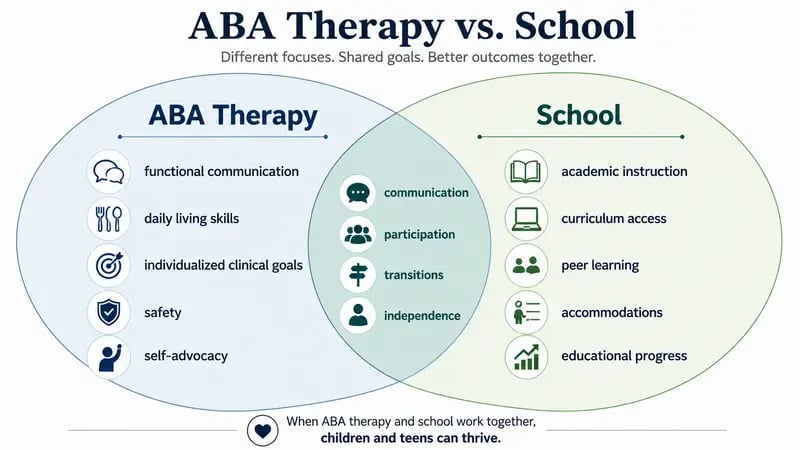
ABA and school may both involve communication, routines, transitions, social interaction, and independence. Their primary responsibilities are different, however.
A treatment plan is built around individualized clinical goals. An educational program is built around access to instruction and educational progress. For eligible public-school students, that may include an Individualized Education Program (IEP), related services, accommodations, supplementary aids, and other supports.
| ABA therapy may focus on | School may focus on |
|---|---|
| Functional communication, including AAC when appropriate | Academic instruction and access to the curriculum |
| Daily routines, self-care, safety, coping, and self-advocacy | Classroom participation, grade-level learning, and school routines |
| Individualized teaching and practice across settings | Instruction with peers, accommodations, and school-based services |
| Skills that help a child express needs and participate | Educational progress within an individualized program or school plan |
The boundary is not always perfectly neat. A school may address functional skills, and an ABA program may practice early learning routines. The distinction still matters because it affects who makes decisions, how services are funded, and what outcomes each team is responsible for measuring.
Neither setting should require a child to hide their communication style, ignore sensory needs, or appear indistinguishable from peers. Useful goals help the child communicate, access learning, stay safe, build independence, and participate in ways that are meaningful to them.
Can a Child Attend School and Receive ABA Therapy?
Yes. Many children attend school and receive ABA therapy before school, after school, on selected weekdays, during school breaks, or through another individualized arrangement.
More therapy is not automatically better. A workable schedule also leaves room for sleep, play, family life, medical appointments, other therapies, and unstructured recovery time. The child's response to the total schedule matters as much as the number of service hours.
ABA goals can complement school without duplicating the school day. A child might practice asking for help, using a break card, following a visual schedule, moving between activities, tolerating a necessary care routine, or participating in a preferred activity with peers. A child who uses pictures or a speech-generating device may also benefit from consistent access to AAC and visual supports across home, therapy, and school.
The objective is not to recreate a classroom in the clinic. It is to help useful skills carry into everyday settings while the school provides instruction and educational support.
When ABA Takes More of a Child's Weekday Schedule
A therapy-heavy weekday schedule may be considered for some younger children who are not yet required to attend school. Even then, the decision should be individualized. Preschool special education, early childhood programs, peer experiences, family routines, and the child's need for rest may all be part of the conversation.
For school-age children, ABA during school hours requires more care. The federal Individuals with Disabilities Education Act makes a free appropriate public education available to eligible children with disabilities and places educational planning with the IEP team. IDEA also favors education with nondisabled peers to the maximum extent appropriate, with needed aids and supports.
Arizona families must also consider state instruction and attendance rules. Arizona Revised Statutes § 15-802 generally requires children ages six through sixteen to attend school and receive instruction through an approved educational arrangement. A clinic-based ABA schedule is not automatically a substitute for that instruction.
Arizona scheduling note: Before reducing a school day, withdrawing a child, or moving therapy into regular school hours, speak with the school or district, the IEP or Section 504 team when applicable, and the ABA provider. Seek qualified education-law guidance when the situation is disputed or unclear. This article is general information, not legal advice.
There are legitimate reasons a child's schedule may look different from a typical full school day. The important point is that a clinical recommendation alone does not settle educational placement, attendance, or access questions.
School Readiness Is About Access, Not Compliance
School readiness is often reduced to sitting still, following every direction, waiting quietly, or speaking in complete sentences. That definition excludes children who can learn with movement breaks, AAC, sensory supports, visual schedules, adapted instruction, or help with transitions.
A better question is not, “Can my child manage school without support?” It is, “What support helps my child access learning, communicate, and participate?”
Useful readiness and access questions include:
- How does my child communicate choices, discomfort, requests, and the need for help?
- What makes transitions and group activities more predictable?
- Can my child request a break or use a reliable regulation strategy?
- What sensory, communication, or instructional supports should travel across settings?
- Which school routines are worth practicing, and which expectations should be adapted?
A visual schedule, movement break, quiet space, or communication device is not evidence that a child is “not ready.” These may be the supports that make meaningful participation possible.
For younger learners who benefit from structured practice with peers, AIA's school readiness program may provide opportunities to work on communication, group learning, flexibility, and independence. It should still be considered as one part of the child's broader education and support plan.
What a Coordinated ABA and School Plan Can Look Like
Coordination does not require identical goals or constant meetings. It means the adults supporting the child understand their roles, avoid contradictory approaches, and share useful information with appropriate permission.
A practical plan may include:
- One or two shared priorities. Examples might include requesting help, using a break signal, completing an arrival routine, or transitioning with a visual cue.
- Clear responsibility. The school team addresses curriculum, accommodations, IEP or Section 504 services, and educational progress. The ABA team addresses treatment goals within its scope. Families decide what is realistic at home.
- A simple communication process. Decide who will exchange updates, how often, and what information is actually useful. Written consent should be in place before detailed records are shared.
- A transition plan when the schedule changes. Classroom visits, photos of the campus, a visual preview, gradual schedule changes, and staff preparation can make a new routine more predictable.
- A way to review the plan. Look at participation, stress, communication, progress, and family capacity. Adjust the schedule when the total load is no longer serving the child.
Coordination is most useful when it improves the child's real life, not when it creates more paperwork or asks every setting to use exactly the same procedure.

Before Changing the School Day, Ask These Questions
A schedule change can affect education, treatment, transportation, insurance authorization, family routines, and the child's energy. It deserves a broader conversation than “school or ABA?”
Use this checklist to prepare for the discussion:
- What specific need is the proposed change meant to address?
- What supports have been tried in the current school setting?
- Is the child eligible for an evaluation, IEP, Section 504 plan, related service, accommodation, or program modification?
- How will academic instruction continue if school hours are reduced?
- How will the family know whether the new schedule is helping?
- When will the plan be reviewed, and what would trigger another change?
Bring concrete observations rather than broad labels. “The lunchroom is overwhelming because of noise and unpredictable seating” gives a team more to work with than “school is not working.” Specific information can point toward accommodations, skill-building, environmental changes, or a different schedule.
How AIA Can Help Families Plan Next Steps
Arizona Institute for Autism provides individualized ABA therapy services for children and families in the Phoenix area. Treatment recommendations are based on the learner's strengths, needs, goals, and response to intervention rather than a one-size-fits-all number of hours.
AIA can help families identify functional goals, prepare questions for school meetings, and coordinate with other professionals when written permission is in place. For younger learners, the AIA Preparatory Academy combines an accredited early childhood curriculum with ABA-informed support in a structured setting.
Families in Scottsdale, Gilbert, Mesa, Tempe, and nearby communities can schedule a free consultation to discuss their child's current needs and possible next steps. A consultation can clarify what questions to bring to a school, IEP meeting, or broader care team. It does not replace educational or legal decision-making.