



Picky eating in autism can be more complex than an ordinary childhood preference for a few favorite foods. Some autistic children eat a narrow range of foods, depend on specific brands or preparation methods, or become highly distressed when an unfamiliar food appears.
These patterns are often described as food selectivity. They may be influenced by sensory differences, a need for predictability, anxiety, pain, gastrointestinal discomfort, chewing or swallowing difficulties, communication needs, or previous negative experiences with food.
The goal is not to make a child eat every food. It is to understand what is making eating difficult, protect the child's nutrition and safety, and help mealtimes become more comfortable and flexible over time.
Picky eating in autism may be connected to sensory differences, predictability, anxiety, pain, gastrointestinal discomfort, oral-motor difficulties, or learned mealtime patterns. Parents can support food exploration without pressure, but weight loss, poor growth, choking, pain, nutritional concerns, or sudden food refusal should be evaluated by a healthcare professional.
Typical picky eating versus autism-related food selectivity
Many young children go through periods when they refuse unfamiliar foods or request the same meal repeatedly. Ordinary developmental pickiness often changes over time and does not significantly interfere with growth, nutrition, health, or daily participation.
Autism-related food selectivity may be more persistent or have a greater effect on everyday life. A child might:
- Eat only foods with a particular texture, temperature, color, shape, or flavor
- Accept one brand but refuse a similar product in different packaging
- Become distressed if foods touch or are presented differently
- Stop eating a familiar food after the recipe or appearance changes
- Avoid entire food groups or most foods served outside the home
- Have difficulty eating at school, restaurants, parties, or family gatherings
- Gag, cough, chew for a long time, pocket food, or struggle with certain textures
The number of foods a child eats can provide useful information, but there is no single food-count cutoff that tells parents whether a feeding disorder is present. Growth, nutritional adequacy, hydration, safety, distress, lost foods, medical symptoms, and family impact all matter.
Why is picky eating common in autism?
There is rarely one explanation for a restricted diet. Several factors can overlap, and what looks like refusal may be a child's way of avoiding discomfort, uncertainty, or a task that feels physically difficult.
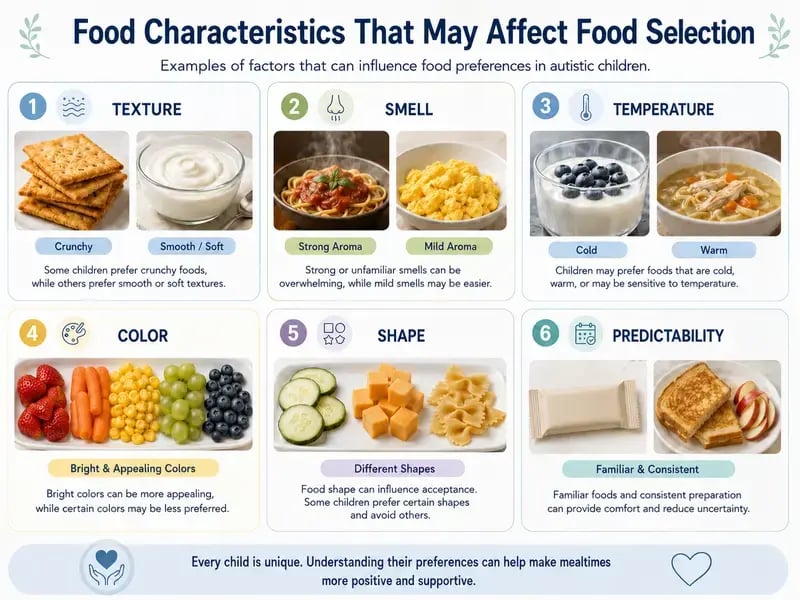
Sensory differences
Food involves many sensations at once. A child experiences its smell, appearance, temperature, texture, sound, and movement in the mouth before swallowing it.
A food that seems ordinary to one person may feel painfully strong, slimy, gritty, unpredictable, or overwhelming to another. Some children seek crunchy or strongly flavored foods, while others prefer bland, smooth, or dry foods.
Sensory preferences are meaningful information. They can help parents and professionals identify foods that may be easier to explore next.
Predictability and sameness
Familiar foods reduce uncertainty. A packaged cracker is usually the same size, color, taste, and texture every time. A strawberry may be sweet one day, sour the next, firm in one bite, and soft in another.
A change in brand, packaging, recipe, shape, or cooking time may make a familiar food feel completely different to an autistic child. This is not necessarily defiance. The child may no longer perceive the changed item as the same dependable food.
Anxiety and previous negative experiences
A child who has gagged, vomited, choked, or experienced stomach pain may become understandably cautious about eating. Even after the original problem improves, the fear associated with certain foods or mealtimes may remain.
Pressure can increase that fear. Repeated demands to “just take one bite” may make the table, plate, or presence of a new food predict an uncomfortable interaction.
A helpful reframe: Food refusal may communicate sensory discomfort, fear, pain, uncertainty, or difficulty chewing and swallowing. Understanding the reason should come before trying to change the behavior.
Interoception and appetite awareness
Interoception is the ability to notice internal body sensations, including hunger, fullness, thirst, nausea, and pain. Some autistic children may notice these signals differently or have difficulty communicating what they feel.
Irregular appetite can also be affected by constipation, illness, sleep, anxiety, medication, or frequent access to food and drinks. Parents should discuss substantial appetite changes with the child's pediatrician rather than assuming they are behavioral.
Oral-motor or swallowing difficulties
Some children have trouble biting, chewing, moving food through the mouth, or swallowing safely. They may avoid meat, raw vegetables, mixed textures, or other foods that require more coordination.
Warning signs can include coughing or choking while eating, prolonged chewing, food remaining in the cheeks, a wet or gurgly voice after swallowing, frequent congestion during meals, or difficulty progressing to age-appropriate textures.
These signs warrant guidance from a pediatrician and, when appropriate, a speech-language pathologist with pediatric feeding and swallowing expertise. See the American Speech-Language-Hearing Association's pediatric feeding and swallowing guidance.
Gastrointestinal, dental, or other medical discomfort
Constipation, reflux, allergies, dental pain, mouth sores, nausea, and other health concerns can make eating uncomfortable. A child may not be able to explain where the pain is or when it occurs.
Medical causes should be considered before feeding difficulties are treated as a behavior problem. A brief record of foods, bowel movements, pain behaviors, vomiting, sleep, and appetite may help the pediatrician identify patterns.

When restricted eating needs professional evaluation
Parents do not need to wait for a crisis before discussing feeding concerns with a pediatrician. Evaluation is especially important when eating patterns affect health, safety, development, or participation.
Contact a healthcare professional if your child:
- Is losing weight, not growing as expected, or appears dehydrated
- Coughs, chokes, has difficulty breathing, or develops a wet-sounding voice during meals
- Frequently gags, vomits, pockets food, or chews for an unusually long time
- Has persistent constipation, reflux, diarrhea, stomach pain, or pain while eating
- Suddenly stops eating foods that were previously accepted
- Avoids food because of fear of choking, vomiting, pain, or another negative consequence
- Relies on a diet that may not provide adequate energy or nutrients
- Has mealtime distress that substantially affects school, family life, or social participation
- Eats nonfood items, which is known as pica
- Requires supplements or specially prepared foods to maintain adequate intake
Call emergency services when a child is choking and cannot breathe, cough effectively, or make sound. New breathing difficulty, severe dehydration, or another acute medical emergency also requires immediate care.
Food selectivity, pediatric feeding disorder, and ARFID
These terms overlap, but they do not mean exactly the same thing.
Food selectivity describes a limited pattern of accepted foods. It is an observable eating pattern, not necessarily a diagnosis.
Pediatric feeding disorder involves impaired age-appropriate eating that may affect medical health, nutrition, feeding skills, or psychosocial functioning. Assessment may involve several disciplines.
Avoidant/restrictive food intake disorder, or ARFID, is an eating disorder in which restriction or avoidance leads to consequences such as significant nutritional deficiency, weight or growth problems, dependence on supplements or tube feeding, or substantial interference with daily functioning. Unlike anorexia nervosa, ARFID is not defined by a drive for thinness or fear of weight gain.
Autistic children can have food selectivity without having ARFID. They can also have ARFID, a pediatric feeding disorder, a swallowing disorder, or more than one concern at the same time. Diagnosis requires qualified professionals.
Creating a calmer mealtime environment
A child is more likely to explore food when the setting feels physically and emotionally safe. Before adding demands, look for environmental barriers.
Consider:
- Is the chair supportive and comfortable?
- Are noise, lights, smells, or conversation overwhelming?
- Is the child tired, constipated, anxious, or in pain?
- Is the meal rushed?
- Does the child have a reliable way to request help, a drink, a break, or “all done”?
- Is at least one familiar food available?
Predictable routines can help, but predictability does not require every meal to be identical. A simple visual sequence, such as wash hands, sit, eat, clear plate, and preferred activity, may make expectations easier to understand.
Do not remove all familiar foods to make a child hungry enough to eat something new. Protecting dependable food access is especially important when nutrition, growth, ARFID, or medical concerns may be present.
Low-pressure strategies parents can try
Home strategies should focus on safety, curiosity, communication, and positive participation. The child does not have to swallow a food for an interaction to count as progress.
Start with observation
Keep a short record for one or two weeks. Note:
- Foods and brands accepted
- Textures, temperatures, shapes, and flavors preferred
- Foods recently lost
- Where the child eats most comfortably
- Signs of pain, gagging, constipation, fatigue, or anxiety
- What happens immediately before and after refusal
Look for patterns rather than judging individual meals. This information can also make professional consultations more useful.
Offer one familiar food
Including a reliably accepted food can reduce uncertainty. The child can then remain near a learning food without facing an all-or-nothing choice between eating it and going hungry.
A familiar food is not a reward for tolerating another food. It is part of making the meal accessible.
Make new foods small and optional
A large serving can feel overwhelming. A tiny piece in a separate dish may be easier to tolerate.
Early steps might include:
- Allowing the food to remain on the table
- Looking at it
- Serving it to another person
- Touching it with a utensil
- Touching or smelling it
- Bringing it near the lips
- Tasting it when the child is ready
Not every child will follow this exact order. A feeding professional may recommend a different approach based on medical, sensory, motor, or behavioral needs.
Use neutral language
Describe foods without pressure or exaggerated praise.
You might say:
- “This one is crunchy.”
- “That sauce smells strong.”
- “You can keep it in the small bowl.”
- “You told me you are all done.”
- “You touched something new.”
Avoid labeling the child as difficult, manipulative, or bad. Also avoid describing a food as something the child “should” like.
Involve the child outside mealtimes
Food learning can happen without an expectation to eat. A child might help choose produce, rinse fruit, stir batter, use a cookie cutter, place food on another person's plate, or sort foods by color.
These activities build familiarity while keeping the interaction predictable and manageable.
Model eating without performing
Children can learn by watching family members eat a range of foods. Keep the modeling natural. Repeatedly commenting on how delicious a food is or watching closely for the child's reaction may still feel like pressure.
Maintain an individualized routine
Regular meal and snack opportunities may support appetite awareness for some children. However, parents should not impose food restrictions or long gaps between meals without considering the child's age, growth, medication, medical needs, and current nutritional intake.
A pediatrician or registered dietitian can help when meal timing, grazing, supplements, or nutrition adequacy are concerns.
What is food chaining?
Food chaining is a gradual approach that introduces foods with characteristics similar to foods the child already accepts. The connection might involve brand, shape, texture, flavor, temperature, or preparation.
For a child who eats one type of thin, crisp French fry, a possible chain might be:
- The familiar fry served in slightly different packaging
- The same brand with a small variation in shape
- A similar fry from another restaurant
- A comparable frozen fry prepared at home
- A slightly thicker potato wedge
This is only an example. Moving directly from crisp fries to mashed potatoes may not be a small step for a child who depends on dry, crunchy textures.
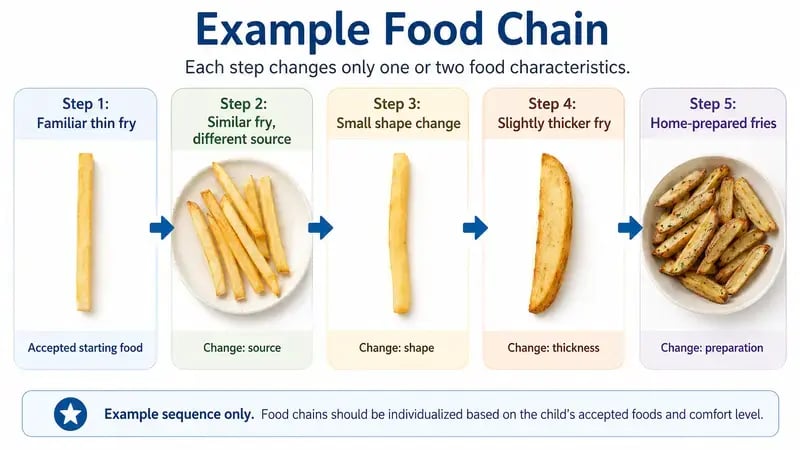
Food chains should be individualized. Children with significant nutritional, swallowing, medical, or ARFID concerns may benefit from professional guidance rather than a parent-designed progression.
Approaches that may increase mealtime stress
Well-intended strategies can backfire when they make eating feel unsafe or unpredictable.
Use caution with:
- Forcing, holding, tricking, or coercing a child to take a bite
- Removing all accepted foods
- Punishing refusal or distress
- Comparing the child with siblings or peers
- Hiding ingredients when discovery could damage trust
- Making every conversation at the table about eating
- Using a single strategy without investigating pain, nutrition, or swallowing
- Attempting a clinical feeding protocol without appropriate training and supervision
This does not mean parents must avoid all expectations or structure. It means that expectations should be individualized, transparent, developmentally appropriate, and safe.

Which professionals can help?
The right professional depends on what is contributing to the feeding difficulty.
| Professional | Possible role |
|---|---|
| Pediatrician | Reviews growth, health, medications, laboratory needs, and referrals |
| Registered dietitian nutritionist | Assesses dietary adequacy and helps protect nutrition while variety is addressed |
| Speech-language pathologist | Evaluates chewing, oral-motor skills, feeding development, and swallowing safety |
| Occupational therapist | May address seating, utensils, sensory participation, and daily routines within the therapist's training and scope |
| Gastroenterologist | Evaluates suspected reflux, constipation, pain, vomiting, or other digestive concerns |
| Psychologist or eating-disorder clinician | Assesses anxiety, fear, ARFID, and other psychological contributors |
| BCBA or behavioral clinician | Assesses communication, mealtime routines, learned avoidance patterns, caregiver implementation, and behavior-related barriers |
Complex feeding problems often require coordinated care rather than a single discipline.
How ABA may support mealtime skills
Applied Behavior Analysis may help when behavioral assessment identifies skills or environmental patterns that affect mealtime participation. ABA should not substitute for medical, nutritional, swallowing, or eating-disorder evaluation.
Depending on the child's assessed needs, appropriate goals may include:
- Requesting a preferred food, drink, break, or different utensil
- Communicating pain or discomfort
- Following a predictable mealtime routine
- Sitting comfortably for a developmentally appropriate period
- Tolerating a learning food nearby without being required to eat it
- Participating in food preparation
- Increasing independence with utensils, cleanup, or lunch routines
- Generalizing accepted foods across safe, manageable changes
- Helping caregivers collect data and respond consistently
Goals should be socially meaningful, culturally appropriate, and coordinated with other professionals when feeding safety or nutrition is involved.
AIA discusses related adaptive-skill supports in Daily Living Challenges in Autism: Eating, Sleeping and Self-Care.
How Arizona Institute for Autism can help
At Arizona Institute for Autism, feeding-related concerns are approached as individualized daily-living and communication needs, not as evidence that a child is being difficult or defiant.
When behavioral support is appropriate, AIA's Board Certified Behavior Analysts may work with families on goals such as functional communication, predictable routines, flexibility around manageable changes, independent mealtime skills, and caregiver consistency.
AIA does not replace evaluation by a pediatrician, registered dietitian, feeding-trained speech-language pathologist, gastroenterologist, or eating-disorder professional. When feeding concerns involve nutrition, pain, growth, swallowing, or possible ARFID, coordinated care is important.
Progress may mean accepting a new brand, remaining comfortable while another food is on the table, asking for a break, touching a learning food, eating more independently, or having a calmer family meal. Eating a particular food should not be the only measure of success.
Families in the Phoenix metropolitan area can contact Arizona Institute for Autism at (480) 687-7099 or request a consultation to discuss whether ABA-related daily-living support may be appropriate.